
How to Make Instant Pot Coconut Yogurt
I first started making this dairy-free coconut yogurt back in 2014. When my daughter was born, she had a Milk and Soy Protein Intolerance (MSPI, for short), meaning that even the slightest bit eaten by me would come through my breastmilk and cause her incredible stomach upset. It only lasted six months, but in that time, I discovered that my body functions better without dairy. It was confirmed later when I did my time on the AIP diet to find food intolerance.
That's how I discovered the amazing versatility of cashew cream. And that's when I started making my own dairy-free Instant Pot coconut yogurt. It's such a great AIP breakfast option (or any dairy-free diet).
Why should I make this coconut yogurt recipe?
Making yogurt in the Instant Pot (dairy-free or otherwise) is so incredibly fool-proof. If you've ever been intimidated by making your own yogurt before, the Instant Pot is your answer. It makes it so hands-off and so simple-it's honestly almost easier than just going to the store to buy premade coconut yogurt.
And my gosh, can you save some serious cash by making your own yogurt at home-especially the dairy-free stuff. At our local grocery store, a five-ounce cup of coconut milk yogurt runs about $1.99. You can make an entire quart-32 ounces worth-of Instant Pot coconut yogurt for less than $4. It'd cost you $12.74 to buy that much pre-made! And when you go through as much yogurt as we do, that adds up fast.
Another (huge) added benefit: you can control everything about your yogurt-the thickness, the tanginess, and most importantly to me, the probiotic levels. Most store-bought yogurts are barely fermented at all-some sources say that yogurt from the store can be fermented for as little as one hour! One hour does not get you much healthy bacteria, but you know what does? Using your Instant Pot to ferment for 24 hours or more. Yogurt that is fermented for 24 hours has more healthy probiotics per cup than any over-the-counter probiotic pill-we're talking billions of good guys helping to keep your gut happy! And it's way more delicious than popping a pill.
Are there any drawbacks to making Instant Pot coconut yogurt?
The one caveat with Instant Pot coconut yogurt-it's never going to get as thick as cow's or goat's milk yogurt without some help. That's because coconut milk just doesn't have the lactose and proteins that transform the texture when fermented.
How do I make thick, creamy homemade coconut yogurt?
If you love good thick yogurt like I do, I highly recommend using any or all of these three ways to get there:
- Use the right coconut milk. Full-fat coconut milk from the can (not "Lite" coconut milk or the coconut milk from the refrigerated cartons) is going to give you the thickest, creamiest yogurt. In fact, if you can find straight-up coconut cream (this is what I usually use), you're going to get the best results.
- Go for a long ferment. Yes, coconut milk won't thicken like cow's milk during fermentation, but it will thicken some. The baseline time I recommend to turn your milk into yogurt is eight hours-but that's not going to thicken your yogurt at all. If you set your fermentation time for closer to 24 or even 36 hours, you're going to get a naturally thicker yogurt.
- Use a thickener and chill. This is absolutely optional, but I usually thicken my yogurt using unflavored beef gelatin (I've also had good results using agar agar for a vegan version). I just add enough to give it a little bit of body-and not turn it into yogurt Jello-and then I chill until completely cold.
It might take you a bit of experimentation to figure out the right combo that makes your family happy. But once you land on it, you'll never go back to buying yogurt again!
What kind of starter do I need for this coconut yogurt recipe?
When you're making your yogurt, you will need to inoculate your batch with either yogurt starter culture or pre-made plain yogurt from the store. I've done both, and they both turn out beautifully. If you choose to use a yogurt starter, this Yogourmet starter is my absolute favorite*. It has very specific strains of bacteria that are great for your tum-tum-my naturopath has actually recommended I eat yogurt only when it's made with the strains in this yogurt starter to protect my gut health.
(*Please note: this starter contains skim milk powder. If you're looking for a completely dairy-free way to start your batch of coconut yogurt, you'll want to use a different starter or a dairy-free yogurt with live active cultures like we mention below!)
The way easier (and cheaper) route is to use premade yogurt as your starter. Just take three tablespoons of whatever plain yogurt you'd like (dairy, soy, coconut, almond-all fine) that has live, active cultures in it-and whisk that in to innoculate your batch of yogurt. Then, when your batch is done, reserve about ¼ cup of it to make your next batch. You'll never have to buy yogurt again! It's the gift that keeps on giving.
What if I don't have an Instant Pot?
Of course, you absolutely don't have to have an Instant Pot to make yogurt. You can do it in the slow cooker or on a heating pad (my preferred method pre-Instant Pot) or even under the light in your oven-basically, any way you can consistently keep your yogurt around 100°F for 8-36 hours while it ferments will do the trick. The Instant Pot just makes keeping the temperature there SO FLIPPING SIMPLE. It removes all the variables and just makes for perfect yogurt every. single. time. Happy yogurtmaking!
How do I flavor or sweeten homemade coconut yogurt?
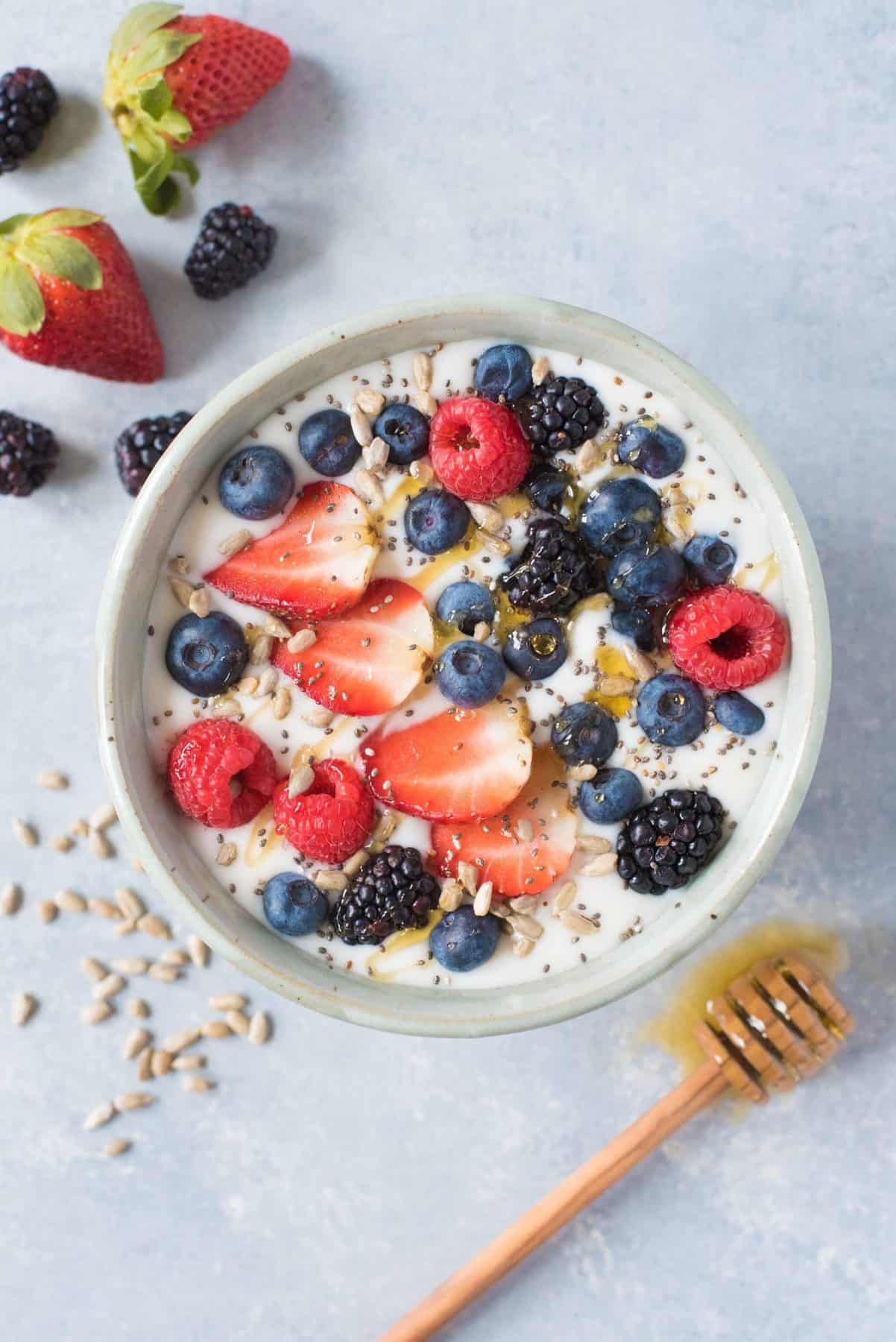
When the yogurt is finished and cooled is a great time to stir in any sweetener, jams, fruit butters or flavoring like vanilla extract to add flavor. Here are some good options:
- homemade pumpkin butter
- homemade apple butter
- simple blueberry jam
- strawberry jam
- strawberry-rhubarb jam
You can also obviously use this yogurt in any recipe that calls for yogurt. Here are some good places to try out your new batch of yog:
- healthy overnight oats
- strawberry chia pudding
- yogurt with fruit on the bottom
- fruit and yogurt parfaits
📖 Recipe
Instant Pot Coconut Yogurt
Ingredients
- 1 quart full-fat canned or boxed coconut milk I get best results from this coconut cream, but any full fat coconut milk will work
- ¼ cup maple syrup do not sub in honey-it has its own bacteria that will fight the yogurt culture
- 3 tablespoons plain yogurt with live active cultures dairy, soy, coconut, almond-all fine OR one packet of freeze dried yogurt culture (I like this one)
- OPTIONAL THICKENER: 1 to 2 teaspoons unflavored grass-fed beef gelatin OR ½ to 1 teaspoon powdered agar agar
Instructions
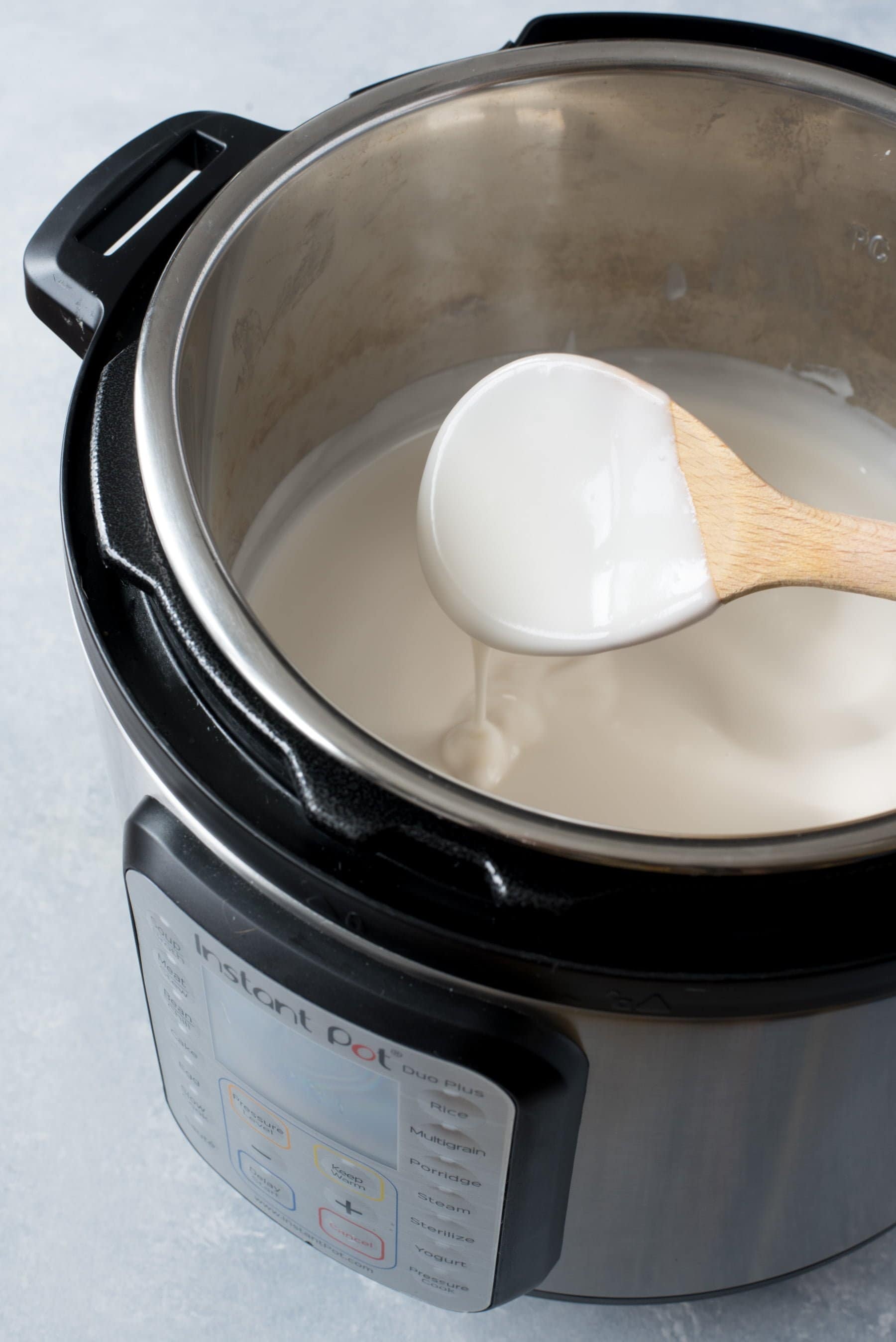
- Pour the coconut milk and maple syrup into the pot of the Instant Pot. Whisk well, then press the "Yogurt" button, and then adjust the setting until you see "boil." Let the Instant Pot run through the process (it's getting the milk up to a temperature of around 185°F), whisking occasionally. No need to place the lid on the Instant Pot during this stage.
- When the Instant Pot beeps that it is finished, allow the milk to cool until it is between 100ºF and 110ºF. This can take upwards of an hour.
- If using starter yogurt: When the milk is at the correct temperature, ladle out about ½ cup of the warm milk into a small bowl, and whisk with the 3 tablespoons plain starter yogurt until smooth. Pour the mixture back into the Instant Pot and whisk well.
- If using freeze-dried yogurt culture: When the milk is at the correct temperature, sprinkle on one packet of the starter culture and then whisk very well to combine.
- If using a thickener, sprinkle on top of the warm milk, and then whisk very well to combine.
- Close the lid of the Instant Pot (no need to seal), and press the "Yogurt" button. Adjust the setting until you see the time display. Set for the desired amount of fermentation time. Eight hours is bare minimum, but I *much* prefer yogurt that has been fermented closer to 24-36 hours. This results in a naturally thick and tangy yogurt-very like regular Greek yogurt. Plus, it has more probiotics! (See notes for more info about time and temp)
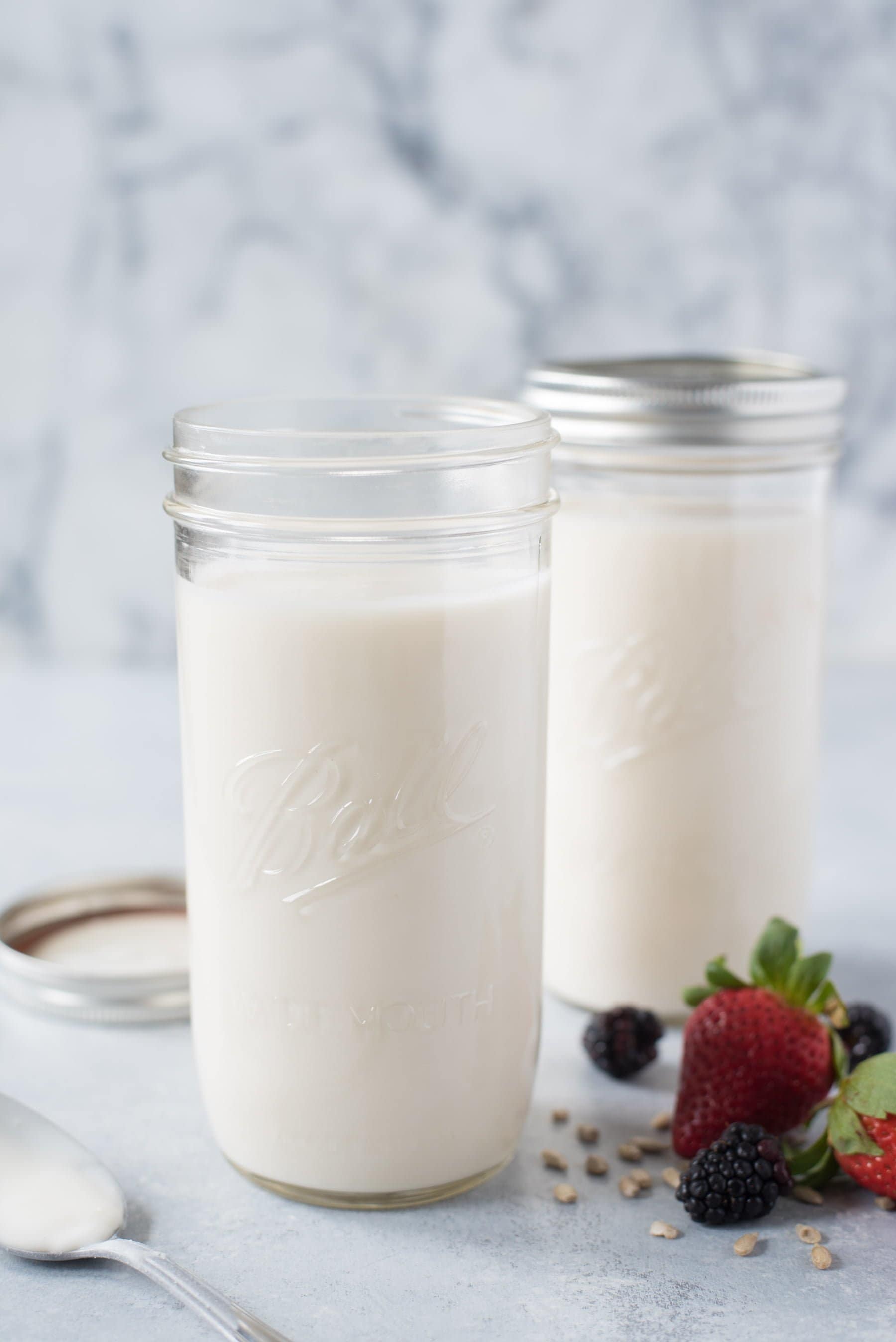
- When the fermenting time is up, transfer the yogurt to a glass storage container (I use a wide mouth quart jar) and keep in the fridge. It will thicken up considerably as it cools.
Video

Notes
- If you like thicker, Greek-style yogurt, I recommend using either the gelatin or the agar agar. However, if you want to leave those our, the longer you ferment, the thicker the yogurt gets naturally.
- If you do use the thickeners, the upper range will get you a thicker, Greek-style yogurt, while the lower will just thicken to a "normal" yogurt consistency.
- Since coconut milk doesn't have the same kind of sugars that cow's milk has, the added maple syrup is to give the bacteria a jump-start meal-they eat almost all the sugars and the resulting yogurt isn't sweetened at all.
- My favorite starter (linked in the post and the recipe above) contains skim milk powder. If you're looking for a completely dairy-free way to start your batch of coconut yogurt, you'll want to use a different starter or a dairy-free yogurt with live active cultures.
- Some people recommend using opened probiotic capsules as yogurt starter, and it can work-depending on your probiotic. Proceed with caution though, as some can make yogurt taste really not good.
- When you spoon your yogurt into a container for storage, make sure to reserve a little bit for the next batch of yogurt in a small jar (I just fill one of these quarter-pints). That way, you'll never be without yogurt starter.
- I love my Thermapen for yogurt-making (and honestly, everything else in the kitchen), but if you don't have a thermometer, it's not a big deal. Another trick is to place a (clean!) finger in the milk-when you can hold your finger in the milk while counting to ten, it's cool enough to pitch in the yogurt starter.
- Some folk in the comments mentioned that their Instant Pot only maintained the desired yogurt fermentation temperature (around 110°F) when set for up to 8 hours. Set for longer than 8 hours, their IP used a lower temperature (around 88°F). Our IP doesn't adjust the temperature in this way, so please check your owner's manual before choosing your time setting!

Hey there, thanks for the recipe! Made it on Saturday and fermented (using the instant pot yogurt setting) on low (91 degrees) for 36 hours and when transferring from the pot to the glass container, it was very runny milk, maybe even runnier than the initial mixture. I followed all instructions, used 2 tsp of agar agar, what went wrong?
Hiya! If the low setting for your yogurt was only 91 degrees then that was most likely what went wrong. The ideal temperature for yogurt bacteria to grow is between 108 degrees and 112 degrees - so most aim for right around 110 degrees to keep the yogurt bacteria happy. Since different models have different settings, the best way to know for sure what setting will have the temperature you need is to check the manual! You're looking for 110 for the yogurt to turn out properly. Let us know how the next batch turns out!
I made your recipe for coconut yogurt with refrigerated organic coconut milk, which has no thickeners like the canned and shelf stable box types. I did not add maple syrup because I wanted no sugars in the yogurt.
I used my smart hot pot on warm, which reads as 107 ºF on both of my candy thermometers.
After 18 hours with the lid covering, I woke to a bit of brown scum partially covering the surface.
Is this normal and safe?
I re-read your recipe directions and stirred into the quart of brew 1/8 cup maple syrup, just in case the good bacteria needs more food.
Hi, Marilinda! That's definitely not normal and we do not recommend eating it. The maple syrup is essential for the recipe to work—there is no sugar in the final product, it is all food for the good bacteria. There's not enough food otherwise, so it doesn't work if you leave it out. Our recommendation would be to discard this batch and give it another go keeping the maple syrup in this time. Let us know how it turns out for you!
Oh boy. At hour 26 of fermentation and just realized I used Guar gum not agar agar. Any chance the batch will still turn out?
Hi, Sofia! The batch should still turn out, though it probably won't thicken as much. Let us know how it goes for you!
I strained to get big chunks out and it wasn’t that thick but was DELICIOUS! I’m about to make another batch with agar agar. My one year old is obsessed with this stuff, thanks for the recipe 😁
Yay! That's so great to hear, Sofia. Thanks so much for taking the time to come back and let us know how it turned out. We're so glad the recipe was a hit!
Is there a way to make yogurt like this but with a chocolate flavor? I’ve looked around but can’t seem to find a site with a recipe that shows when or where you can add a chocolate flavor.
Hi, Alex! If you want to make any yogurt chocolate flavored, you can add cocoa powder and sweetener to taste to the finished yogurt. Let us know how it turns out for you!
HELP! I just made this recipe using the coconut creme and the powdered agar agar that you suggested and cooked it for 36 hours in my Instant Pot. I used dairy active culture plain yogurt for a starter along with maple syrup. When it was finished, it looked great, and I poured it into glass snapware containers. I just took one out to eat, and it separated into a liquid on the bottom and a thick layer of solid fats on the top. How did this happen?? Is this common? I made this once before and cooked 24 hours and it came out fine, but just a little thinner than I wanted.
Hi, Karen! Coconut milk yogurt can separate. We've noticed it ourselves sometimes when we make it (different coconut milks behave differently), and we've seen a few comments like this from folks who made it with coconut creme, as well. The good news is your yogurt is fine, though! A quick whirl in the blender should turn it back into a nice, creamy yogurt again!
I was wondering if I can make this in a crockpot as I do not own an instapot. What setting should I do?
Hi, Heather! This recipe was specifically created for the Instant Pot, so your best best would be to find another recipe that uses the cooking method you're looking for. Unfortunately, without knowing the exact temperatures that your slow cooker runs at, it would be really hard for us to say whether or not the recipe would turn out well! Best of luck with your search!
I tried this and it did not work at all. It was like kefir even with the thickener. For those of you having issues, check that you have the instant pot on the "more" setting. My yogurt function has a "more" and "less" setting. I had it on the "less" setting which turns out it's for making a fermented rice dish and only keeps it at 80-85F. The "more" setting is the yogurt temp. Sad that I wasted a whole lot of time, but I guess I know now.
Hi, Amy! We're so sorry to hear this didn't work well for you. But thank you so much for taking the time to come back to tell us about it! Now anyone else with similar settings on their Instant Pot will know to use the "More" setting and we'll be better able to troubleshoot, as well. Thank you so much! Good luck with your next batch!
When making yogurt why do you do boil in the instant pot? I’ve seen many recipes say push yogurt button on medium set timer 8 hours max then into the fridge 8 hours max. Just wondering why the boil option is needed when using the yogurt button on the instant pot.
Hi Linda! Heating the milk to 185 degrees pasteurizes the milk so that it's sterilized before you introduce your starter culture. This is a necessary step whether you choose to make your yogurt in the Instant Pot or not. The IP just makes it a little easier by regulating the temp for you and doing it automatically! Hopefully this helps clear up any confusion!
Hello! Does this have to be used with maple syrup? Is that required for the process or something? I would like to omit if at all possible. Thanks!
Hi, Jessica! The maple syrup isn't acting as a sweetener in this recipe—it's food for your starter culture. So you could swap in another caloric sweetener of your choice (anything except honey, which is noted in the recipe card), but you can't omit it altogether. The sugars should all be consumed in the fermentation process, so your final yogurt will be unsweetened. We recommend folks sweeten to taste after, if needed. Hope this helps!
Hi, I just bought an Insta pot to make vegan yogurt but didn’t realize the new one doesn’t have a yogurt button. Will the sous vide button work the same way? Thanks so much!
Hi, Steph! No one here at Team Wholefully has one of the new Instant Pots with the sous vide button, so we haven't tried it ourselves. That said, we think you might still be able to make yogurt using it. If the sous vide button allows you to set the temperature for a steady 110 degrees it should work.
First you'll need to prep it on the stovetop. Using the Yogurt button would have done this part this right in the IP, but you can definitely do it one the stove! Heat the coconut milk and maple syrup in a pot on the stove stirring occasionally until it reaches around 185 degrees. Then let is cool until it's between 100 and 110 degrees. Pitch in your starter culture and mix it up well. Then pour it all into the IP set to 110 degrees for however long you want to culture it (we recommend 24-36 hours). That should do it!
If you give it a go, please let us know how it works out for you!
Can you substitute date paste or date syrup for the maple syrup?
Hi, Beth! We haven't tried it, but it should work. As long as it's a caloric sweetener (and doesn't have its own bacteria to fight the culture like honey does) it should be fine! Let us know how it turns out for you!
After you put the yogurt in the jars do you let it cool down before putting it in the fridge or just put it straight in?
Hi, Peter! You could do it either way. It should be cool enough to go right into the fridge without making everything else in there too warm. But if you'd rather let it cool down to room temperature first, it would be fine sitting out for a bit. It may get tangier the longer it's left at room temperature, though, so be sure to check it for taste! Hope this helps =)
Should I skim the top after boil function? When I make cow’s milk yogurt I always skim the fat. Or should I just mix it in? Thanks!!!
You shouldn't need to skim anything off when making this!
SO many yogurt recipes include a sterilization step for your equipment. This recipe does not. Is that an oversight or something not necessary with coconut milk? Seems weird that you wouldn't do this....
If sterilizing your equipment would make you feel more comfortable, you are more than welcome to do that! In all of our fermentation recipes, we lean more toward the traditional methods used for centuries–which don’t typically rely on sterilization.
A good wash of soap and water does the trick for us!
I've made this recipe a bunch of times from a starter and from my own yogurt batch afterwards. I'm wondering if once I've made a batch I can freeze 1/4 cup for the next time I want to make yogurt or will that kill the bacteria in it? Thanks so much!
Freezing is usually okay with bacteria, but I have never tried it, so I can't be 100% certain. Let us know if you do try it!
Question .... if my instapot does have a boil setting once I get the tempature to 185 how long should it boil?
No need to boil for any amount time, just bring it to that temp and then shut it off. 🙂
When I make the yogurt as per instructions it has a slightly bitter aftertaste that I cannot figure out how to get rid of. Any suggestions?
Hello,
Do you reserve the yogurt for future starter before the maple syrup is added or after? Thank you.
Before. 🙂
Can I make use of fresh extracted coconut milk from coconuts for my coconut yogurt?
I've never tried it (fresh out of coconut trees here in the Midwest), but I don't see why not!
Oh, I'm so sad! Mine smells lovely and tastes tangy, but it's runnier than kefir. I started it with GT's COCOYO Pure. Like I said, it's tangy, but thin. 😞
Yup! Coconut yogurt doesn't thicken like dairy milk. It'll thicken slightly in the fridge, or next time, you can try adding a thickener like we suggest. 🙂